
Mining Himalayan Pink Salt: Process, Location, History & Sustainable Practices
Himalayan pink salt is one of the most popular natural minerals in the world, yet most people have no idea where it comes from or how it reaches their kitchen. Here is everything you need to know about mining Himalayan pink salt, where it is found, how it is extracted, and why responsible mining matters.
What Is Mining Himalayan Pink Salt?
Himalayan pink salt mining is the extraction of natural rock salt from deep underground deposits in Pakistan. Unlike sea salt, which comes from evaporated seawater, pink rock salt is a solid form of sodium chloride that formed around 250 million years ago when an ancient ocean dried up and its minerals crystallized under layers of rock.
Where Is Himalayan Pink Salt Mined?
Despite the name, Himalayan pink salt is not mined in the Himalayan mountains. It comes from the Salt Range, a chain of hills in Punjab, Pakistan, roughly 300 kilometres from the actual Himalayas. The name refers to the broader geological region.
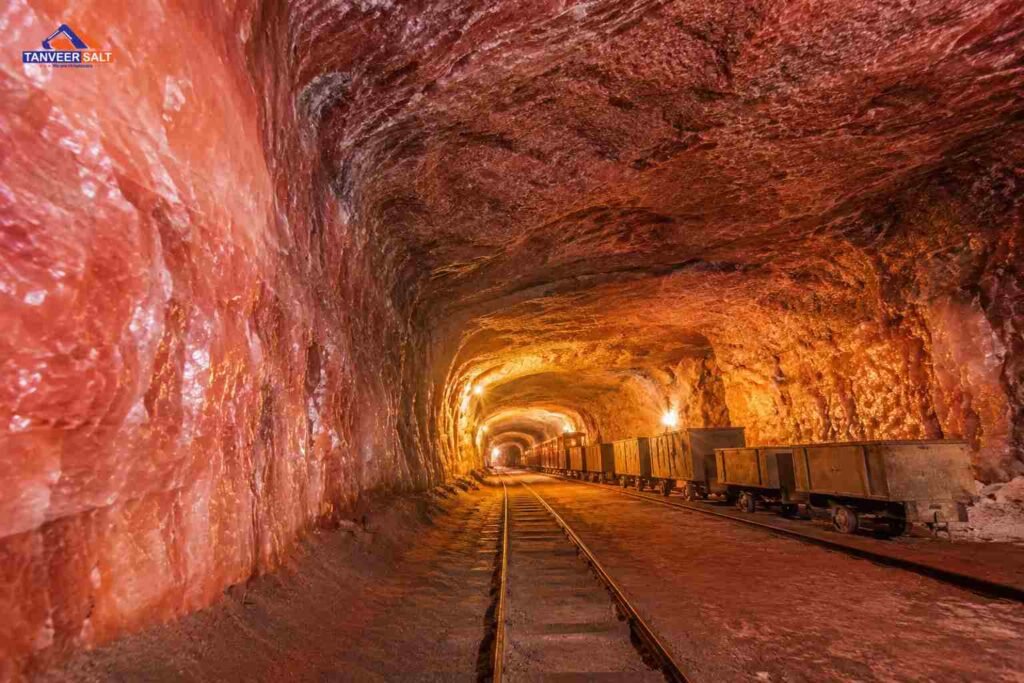
The source is the Khewra Salt Mine in Jhelum district, Punjab, the largest pink salt mine in the world and one of the oldest working mines on earth. Nearly all commercially available Himalayan pink salt originates here, sitting on sedimentary deposits left by that ancient evaporated ocean.
History of the Khewra Salt Mine
Local accounts say the deposit was discovered around 320 BC when horses travelling with Alexander the Great’s army were found licking the rocks. Soldiers tasted them and found salt making Khewra over 2,000 years old as a working mine, though the salt deposit itself is approximately 250 million years old.
Mining expanded during the Mughal period, then British colonial administrators formalized operations in the 19th century, introducing systematic tunneling still used today. The mine is now managed by the Pakistan Mineral Development Corporation and remains the world’s largest pink salt mine, producing hundreds of thousands of tonnes annually for domestic use and global export.
How Is Himalayan Pink Salt Mined?
The pink Himalayan salt mining process follows a structured sequence:
Surveying
Geologists map the salt veins and assess deposit quality before any extraction begins.
Tunnel development
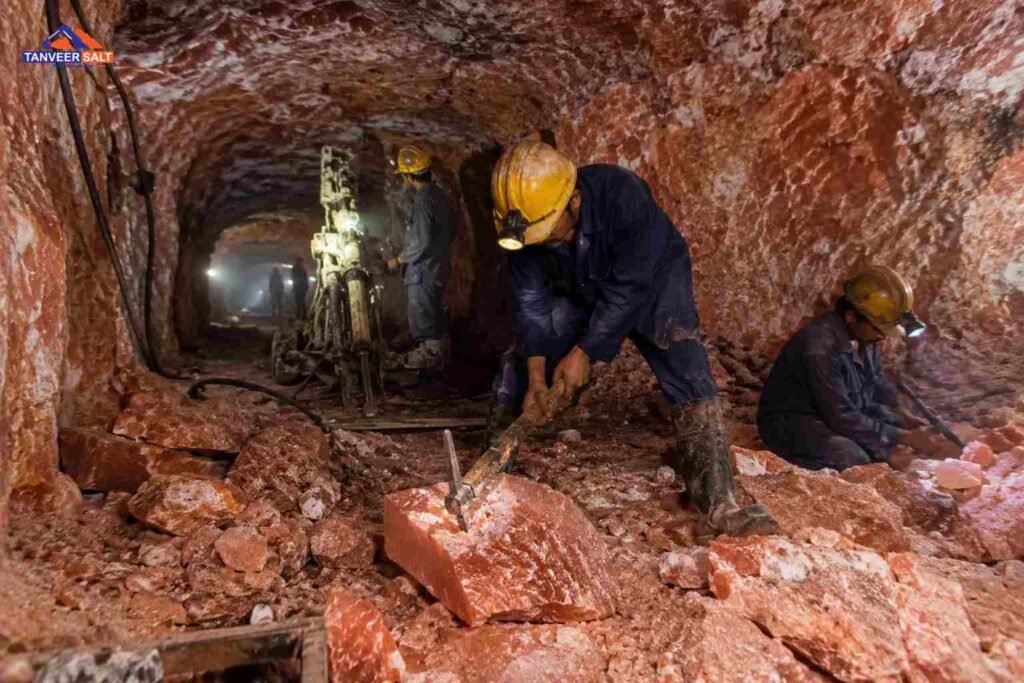
Mining tunnels are carved into the rock to give workers and equipment access to the underground salt deposits.
Drilling
Specialized equipment drills into the salt face to prepare it for extraction.
Controlled blasting
Where needed, small controlled blasts break larger salt formations into manageable pieces without damaging surrounding chambers.
Manual extraction
Much of the work is still done by hand, which is why Himalayan pink salt is widely described as hand mined salt. Workers use picks and hand tools to break salt away from the walls.
Transportation
Extracted salt is loaded onto carts and moved through the mining tunnels to the surface for processing.
Himalayan Pink Salt Mining Process: Step by Step
Once raw salt reaches the surface, it goes through a full processing sequence:
- Sorting: separated by size, color, and grade
- Washing: surfaces cleaned to remove dust and debris
- Crushing: large chunks broken down into smaller pieces
- Grinding: reduced to required grain size, from coarse salt to fine grain salt
- Screening: sieved for consistent sizing
- Quality inspection: food grade salt tested for purity and mineral composition
- Packaging: packed according to product type and destination
- Export: shipped to importing countries worldwide
Sustainable Mining Practices
Sustainability is central to how the Khewra Salt Mine operates. The primary method used is room and pillar mining as tunnels and chambers are carved out, large pillars of salt are left standing to support the structure. Miners extract only around 50% of the available salt in any area, leaving the rest as structural support.
This keeps the mine stable and productive long term. Dust management, ventilation, and worker safety are all part of responsible salt mining at Khewra.
Why Is Himalayan Pink Salt Pink?
The color comes from iron oxide present in the salt crystals. The exact shade from pale pink to deep red depends on the iron concentration and the mix of other trace minerals in each formation.
Himalayan pink salt contains up to 84 trace minerals including calcium, magnesium, potassium, and iron. These are locked into the crystal formation naturally during the geological process, not added during processing.
What Does the Inside of a Pink Salt Mine Look Like?
Inside the Khewra Salt Mine is a network of carved salt tunnels, vast underground chambers, and walls that glow pink and orange under lighting. Notable features include a salt mosque built entirely from salt bricks, a small underground lake, and decorative structures built by miners over centuries.
The mine is open to tourists and is one of Pakistan’s most visited attractions, a rare chance to see a working underground salt mine up close.
Is Himalayan Pink Salt Mined by Hand?
Partially. Traditional hand mining techniques are still used where precision matters workers chip away at salt faces with hand tools. Modern equipment handles drilling, transportation, and crushing, balancing quality with efficiency.
From Mine to Kitchen
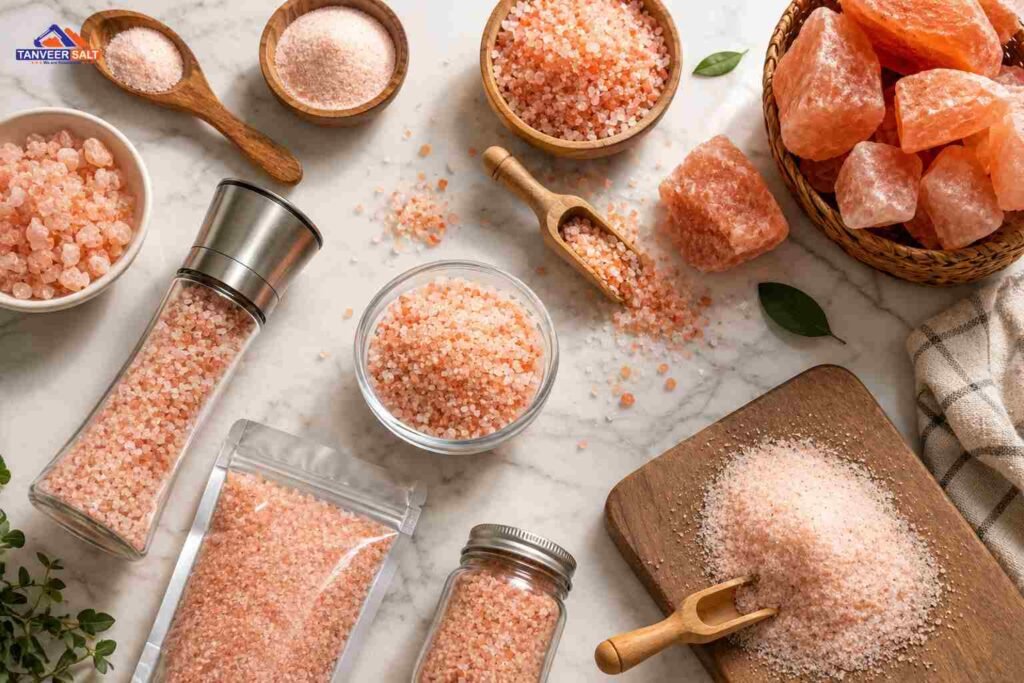
After processing, Himalayan pink salt reaches consumers in several forms — edible Himalayan salt for cooking, gourmet coarse and fine grain versions, salt slabs, salt lamps, animal salt licks, and spa products.
Global Export of Himalayan Pink Salt
Pakistan is the world’s leading Himalayan salt exporter. The United States, Europe, India, and Australia are among the largest importing countries. Global demand has grown significantly as consumers seek natural, minimally processed food products.
Export quality salt goes through strict grading before shipment, covering food-grade, industrial, and decorative grades for both retail and commercial buyers.
Common Myths About Himalayan Pink Salt Mining
Is it mined in India?
No. All authentic Himalayan pink salt comes from Pakistan, specifically the Khewra Salt Mine in Punjab.
Is it sea salt?
No. It is rock salt, a solid mineral from underground deposits, not harvested from seawater.
Is it chemically processed?
No. Processing involves physical steps only crushing, grinding, washing, and screening. No chemicals involved.
Is all Himalayan salt from Pakistan?
Yes. Despite the name, all commercially sold Himalayan pink salt comes from Pakistan. Anything claiming otherwise is mislabeled.
Frequently Asked Questions
Can tourists visit Khewra Salt Mine?
Yes. It is open to visitors and features illuminated tunnels, salt chambers, a salt mosque, and an underground lake.
Is Himalayan salt better than sea salt?
Both are natural salts with similar sodium content. Himalayan pink salt contains more trace minerals due to its geological origin, but the health difference at normal consumption levels is small.
How do they mine Himalayan pink salt?
Through tunnel development, drilling, controlled blasting in some areas, and manual hand extraction, followed by surface processing.
Is Himalayan salt good for high creatinine?
This is a medical question best discussed with a doctor. People with kidney concerns are generally advised to monitor all sodium intake.
Is 1 teaspoon of pink salt a day too much?
One teaspoon contains roughly 2,300mg of sodium, which is the recommended daily upper limit for most adults. A doctor or dietitian can advise based on individual health needs.
Can pink salt help with muscle cramps?
Sodium and electrolytes in salt play a role in muscle function. For persistent cramps, consult a healthcare professional.
Conclusion
Mining Himalayan pink salt is a process rooted in 250 million years of geological history and centuries of human activity. The Khewra Salt Mine in Pakistan’s Salt Range remains the world’s largest pink salt mine and the source of nearly all commercially available Himalayan pink salt. Sustainable room and pillar mining keeps the deposit stable and productive, while growing global demand continues to make this remarkable natural mineral one of Pakistan’s most valuable exports.
About the Author
Laiba is a content specialist at Tanveer Salt Traders, a Himalayan pink salt supplier sourcing directly from the Khewra Salt Mine in Pakistan’s Salt Range.