
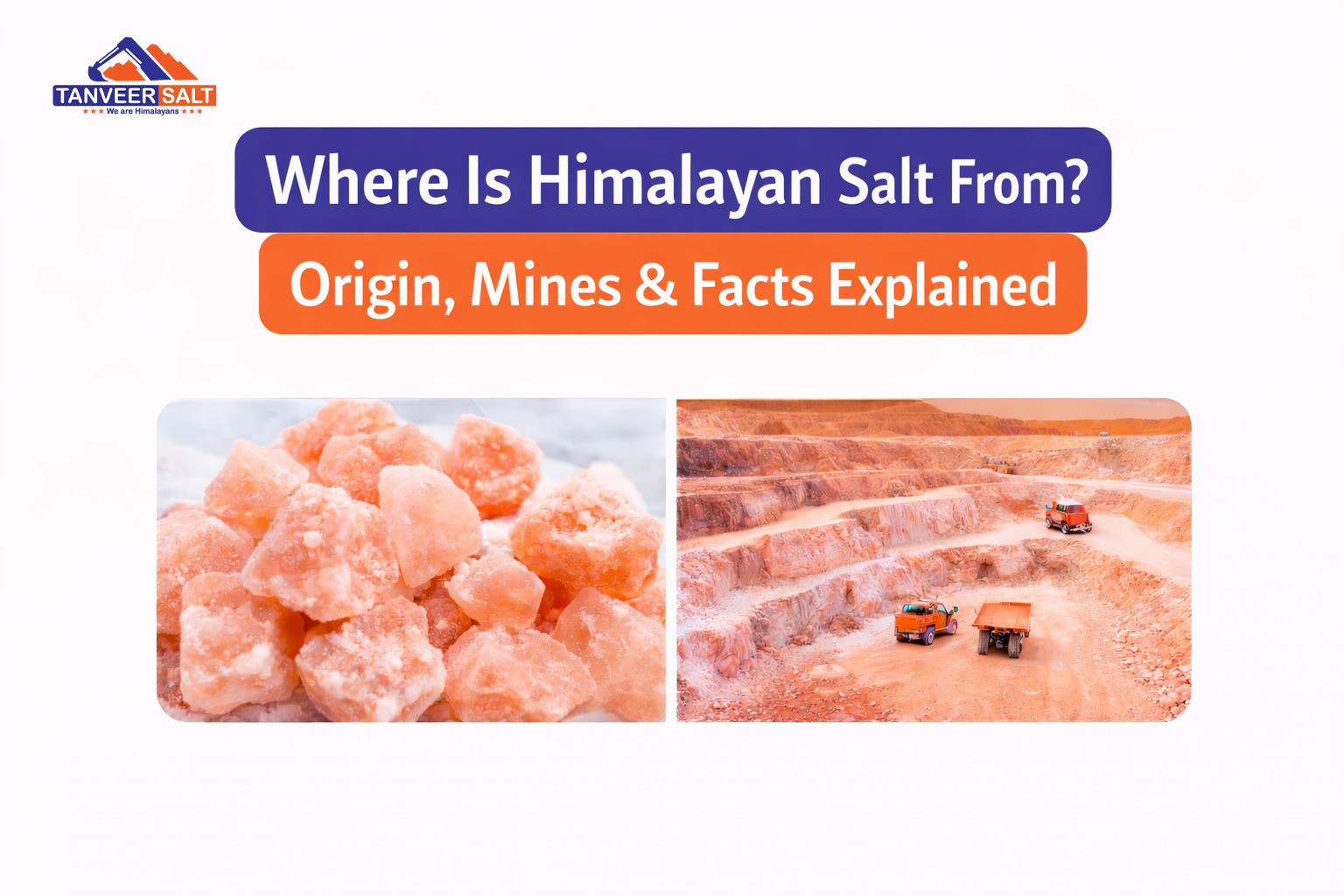
 Where Is Himalayan Salt From? Origin, Mines & Facts Explained
Introduction
Where is Himalayan salt from? This question is commonly asked because pink Himalayan salt is the best substitute for table salt. Additionally, a lot of customers are worried about the origin of Himalayan salt, particularly whether it comes from Pakistan or India. It basically originated from Pakistan, not directly from Himalaya. It mainly comes from Khewra mine salt, which is in Punjab, Pakistan. This salt is mined by hand or traditional methods which help keep the salt in large crystals. After mining, salt is washed and crushed, but usually not heavily processed. Its color is pink because it contains trace minerals, especially iron. There are different shades of pink depending on the mineral content. This article will talk about the true origin of Himalayan salt, explain its geological background, identify the exact country it comes from, and distinguish between scientific facts and marketing claims.
What is pink Himalayan salt?
Pink Himalayan salt is a natural mineral salt that can also be referred to as Himalayan pink rock salt. It is a type of rock salt extracted from underground salt deposits and in the beginning, it is used for culinary purposes. The salt’s pink color comes from naturally occurring minerals, particularly iron compounds. Pink Himalayan salt, unlike standard table salt, is considered unrefined, which means it has undergone minimal processing and typically contains no added anti-caking agents.
The key differences from table salt include:
- Naturally occurring trace minerals
- Coarse crystal structure
- Less processing than refined salt.
- Frequently used in food-grade salt products and gourmet cooking.
Where Does Himalayan Salt Come From? (Exact Location Explained)
The origin of pink salt and pink Himalayan salt is a common question, and the answer is well-established. The Salt Range mountains in Punjab, Pakistan are the only source of Himalayan salt. These deposits were formed from ancient sea salt deposits that are believed to be hundreds of millions of years old. According to geology, salt is created when ancient seas evaporate, leaving behind thick layers of mineral-rich sedimentary rock. Pink Himalayan salt, also known as Himalayan pink rock salt, is a naturally occurring natural mineral salt. This type of rock salt is mostly used in culinary use and is extracted from subterranean salt mines.
Himalayan Salt Origin – Historical Background
The Himalayan salt origin dates to over 250 million years. The area that is now northern Pakistan was submerged under shallow waters during this time, and thick layers of ancient salt deposits were left behind when the seas dried up, eventually becoming buried under sedimentary rock. There is proof of centuries-old salt mining history in this region, showing that people have been extracting salt here for a very long time. Salt from these ancient salt deposits was used in old trade routes, and historical references often mention it, showing its importance long before modern mining methods were developed.
Himalayan Salt Mines in Pakistan
The Khewra Salt Mine, situated in Punjab, Pakistan’s Salt Range, is the most well-known Himalayan salt mine. It is the main source of pink Himalayan salt used worldwide and the biggest and oldest salt mine in the nation. The Salt Range is home to several other Himalayan salt mines in addition to Khewra.The goal of the mining process is to create food-grade salt that is safe and has little effect on the environment.
Himalayan Salt Mountains and the Salt Range
The phrase “Himalayan salt mountains” can be misleading. The pink salt does not come from the snowy peaks of the Himalayas. It is mined from the Salt Range in Pakistan, a smaller mountain area near the Himalayan foothills. Geologically, the Salt Range is part of the greater Himalayan region, which is why the salt is called “Himalayan.” For people who want correct information about where minerals come from, this explanation is important.
Why Is Himalayan Salt Pink? (Mineral Composition Explained)
Himalayan salt is pink because it has tiny amounts of iron and other natural minerals in it. Most of the salt is still sodium chloride (like regular table salt), but it also has small amounts of iron, calcium, potassium, and magnesium. These minerals give the salt its pink, red, or orange color. The color is completely natural. No artificial dyes or coloring are added.
Is Himalayan Salt Good for You? (Science vs Marketing)
Many people wonder, “Himalayan salt, is it good for you?” and want to know its real benefits.
Balanced section:
What science says:
Himalayan salt is mostly sodium chloride, just like regular salt. Eating too much can cause the same health problems as other salts. It does have tiny amounts of minerals, but they are very small.
What is marketing hype:
Some ads make big claims about health benefits, but Himalayan salt is not a cure or special supplement. Scientists say it should be used sparingly, just like normal salt.
Advantages of Pink Himalayan Salt (Balanced & Practical)
Himalayan pink salt has some useful benefits, particularly when it comes to processing and cooking.
The following benefits of pink Himalayan salt are frequently mentioned:
- Trace minerals found in nature
- Compared to refined salt, less processing
- Absence of artificial additives
- Mild flavor and unique texture
These advantages of Himalayan pink rock salt are more closely associated with culinary preferences, taste, and quality than with health benefits.
Himalayan Salt for Cooking and Culinary Use
Both home and commercial kitchens use Himalayan salt for cooking. It is frequently utilized for:
- Seasoning vegetables and meats
- Completing the dishes
- Salt blocks and grinders
Using pink when cooking Himalayan salt adds a subtle taste and aesthetic appeal. However, because it has the same sodium content as other salts, moderation and safety are crucial.
FAQs:
Is Himalayan salt from the Himalayas?
No. It does not come from the Himalayas peak; instead, it comes from the range near the Himalayan foothills.
Is Himalayan salt from India or Pakistan?
Himalayan salt is mined in Punjab, Pakistan.
Why is pink Himalayan salt controversial?
Many health claims about it are mostly marketing and don’t have strong scientific proof. People should be careful and not believe all of them.
Is Himalayan salt better than regular salt?
Himalayan salt is essentially the same as ordinary salt, but it tastes slightly different and contains some additional minerals. Preference is more important than health advantages.
Conclusion
So, where is Himalayan salt from? Khewra Salt Mine is the most well-known source of Himalayan salt, which is derived from ancient sea salt deposits found in Punjab, Pakistan’s Salt Range mountains. Knowing its actual origin enables readers to confidently and clearly select salt products by separating geological facts from marketing myths.