
Does Pink Himalayan Salt Have Iodine
Does pink Himalayan salt have iodine, and should you rely on it for your daily needs? Many people are switching to pink salt because of its natural appeal and trace minerals, but they are also concerned about iodine and thyroid health. Yes pink Himalayan salt does contain iodine, but only in trace amounts that are far too low to meet your daily requirement. In this guide, you will find exact numbers, comparisons, and simple ways to avoid iodine deficiency.
Why iodine matters and how much you actually need
The thyroid gland uses iodine to make the thyroid hormones T3 and T4, which regulate growth, metabolism, energy levels, and brain development.
If your body does not get enough iodine, it can lead to:
- Goiter (enlarged thyroid gland)
- Hypothyroidism (slow metabolism)
- Fatigue and weight gain
- Developmental problems in children
- Increased risks during pregnancy
Daily iodine requirement
| Group | Requirement |
| Adults | 150 mcg |
| Pregnant women | 220 mcg |
| Breastfeeding women | 290 mcg |
| Children | Varies by age |
Iodine deficiency used to be very common, which is why salt iodization was introduced in 1924. Iodized salt is still one of the best methods for preventing iodine deficiency in the world today.
Does pink Himalayan salt contain iodine? Exact numbers
Yes — but only in trace amounts.
- Pink Himalayan salt: <0.1 mcg iodine per gram
- Iodized table salt: ~71 mcg iodine per ¼ teaspoon
- Recommended daily intake: 150 mcg
To meet your daily iodine needs using only pink Himalayan salt, you would need to consume over 1.5 kg per day, which is extremely unsafe and far beyond the recommended sodium intake.
Conclusion: For thyroid health, pink Himalayan salt is not a dependable source of iodine.
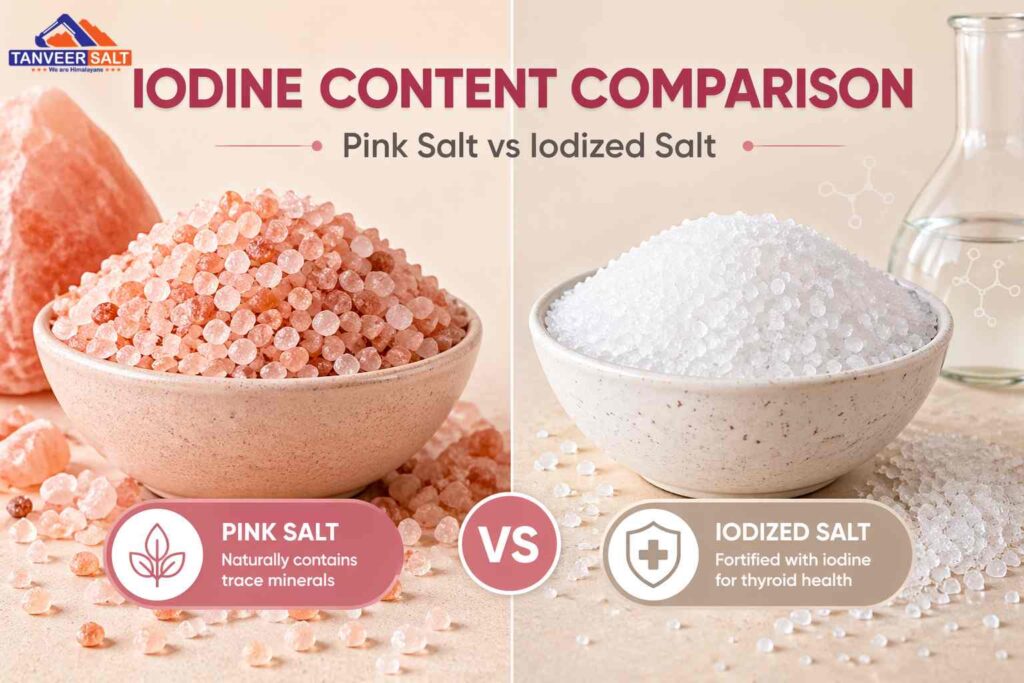
Himalayan salt vs iodized salt (full comparison)
| Feature | Himalayan Salt | Iodized Salt |
| Iodine content | Trace only | High |
| Processing | Unrefined | Refined and fortified |
| Trace minerals | Present (very small amounts) | Minimal |
| Taste | Mild, slightly mineral-like | Neutral |
| Colour | Pink | White |
| Sodium per teaspoon | Similar | Similar |
| Best use | Flavor and presentation | Daily iodine intake |
| Price | Higher | Lower |
The idea that “natural iodine is better” is widely believed, but it is untrue. Whether iodine is added or found naturally, the body absorbs it in the same manner.
Some brands now offer iodized pink Himalayan salt, which combines the natural look of pink salt with added iodine. If you want iodine but prefer pink salt, this might be a good choice. It is also important to note that both sea salt and Himalayan salt naturally contain very low iodine levels.
Final takeaway: Use iodized salt for iodine intake and pink salt for flavor if you prefer — a balanced approach works best.
How to read a pink salt label for iodine
If you are unsure whether your salt contains iodine, checking the label is the easiest way to find out. Look for:
- “Iodized” appears on the packaging.
- Ingredients such as potassium iodide or potassium iodate
- A nutrition label showing iodine content
If none of these are present, the salt does not contain added iodine.
Most pink Himalayan salts are not iodized because iodine can break down faster in unrefined salts that do not contain stabilizers.
If you use pink salt: how to get enough iodine
You do not need to stop using pink Himalayan salt — you just need to make sure you get iodine from other sources.
Iodine-rich foods:
| Food | Iodine per serving | Notes |
| Seaweed (nori) | 16–43 mcg per sheet | Very rich source |
| Cod (fish) | ~99 mcg per 85g | High protein |
| Milk | ~56 mcg per cup | Common source |
| Yogurt | ~75 mcg per cup | Easy to include |
| Eggs | ~24 mcg per egg | Convenient |
| Tuna | ~17 mcg per 85g | Moderate source |
Simple ways to maintain iodine intake
- Use a combination of pink and iodized salt.
- Include iodine-rich foods in your daily meals
- Be cautious on plant-based diets, as deficiency risk is higher
- Consider supplements only if needed and after medical advice
You can also explore more about Himalayan salt and its uses:
- Bathing in Pink Himalayan Salt
- Advantages of Himalayan Salt
- Pink Himalayan Salt and Epsom Salt
- Is Himalayan Salt Good for You
Common myths about Himalayan salt and iodine
Myth 1: Pink Himalayan salt has enough iodine
✔ Fact: It contains less than 0.1 mcg per gram, far below daily needs
Myth 2: Natural iodine is better than added iodine
✔ Fact: The body absorbs both forms the same way
Myth 3: Himalayan salt prevents thyroid problems
✔ Fact: Only adequate iodine intake prevents deficiency
Myth 4: 84 trace minerals make it highly nutritious
✔ Fact: These minerals are present in very small amounts and do not provide significant benefits
Myth 5: All pink salts are the same
✔ Fact: Some brands offer iodized versions, so always check labels
FAQ
Q1: Does pink Himalayan salt have iodine?
Yes — but only in trace amounts (less than 0.1 mcg per gram), far below daily needs.
Q2: Does Himalayan salt contain iodine?
Yes, naturally — but in very small amounts that are not enough for thyroid health.
Q3: Does pink Himalayan salt have enough iodine?
No. You would need to consume over 1.5 kg per day, which is unsafe.
Q4: Is there iodine in Himalayan salt?
Yes, but not enough to prevent iodine deficiency.
Q5: Does Costco or Kirkland pink Himalayan salt have iodine?
No, most brands are not iodized. Always check the label.
Conclusion
So does pink Himalayan salt have iodine? Yes — but only in trace amounts that cannot meet your daily thyroid needs.
In short, pink Himalayan salt is not an iodine source:
- pink salt ≠ iodine source
- always check your brand label for added iodine
- get iodine from iodized salt or iodine-rich foods

Want to explore more about pink salt and its health effects? Read our related guides below:
- Learn more about Himalayan salt benefits
- Read Himalayan salt bath guide
- Explore Himalayan salt usage guide
For better nutrition, consider using iodized salt or an iodized pink salt option to support healthy iodine intake.
Disclaimer
This article is for informational purposes only. Consult a healthcare provider or registered dietitian about your iodine needs, especially during pregnancy or if you have a thyroid condition.
References
World Health Organization (WHO) — Iodine Deficiency & Salt Iodization
https://www.who.int/health-topics/iodine-deficiency
National Institutes of Health (NIH) — Iodine Fact Sheet for Health Professionals
https://ods.od.nih.gov/factsheets/Iodine-HealthProfessional/
Fayet-Moore et al. (2020), Foods Journal — Iodine content in salt and dietary intake Studies
https://www.mdpi.com/journal/foods
American Heart Association (AHA) — Sodium intake recommendations and heart health
https://www.heart.org/en/healthy-living/healthy-eating/eat-smart/sodium
One Response