
Does Himalayan Salt Expire? The Complete Answer on Shelf Life & Storage
Does Himalayan salt expire, or does pink Himalayan salt go bad over time? The short answer is no but there’s more to know about why the packaging has an expiry date, what can actually go wrong, and how to store it correctly.
This guide covers why Himalayan pink salt doesn’t expire, how long it actually lasts, what that best-before date on the bag means, the quality issues that can come up over time, how it compares to sea salt, rock salt, and table salt, and the simple storage habits that keep it fresh for years.
Why Himalayan Salt Does Not Expire The Science Explained
Most foods expire because microbes break them down. Bacteria, fungi, and molds need organic material proteins, fats, carbohydrates to grow and spread. Himalayan pink salt has none of that. It’s a crystalline mineral, not an organic compound. There’s nothing for microbes to feed on.
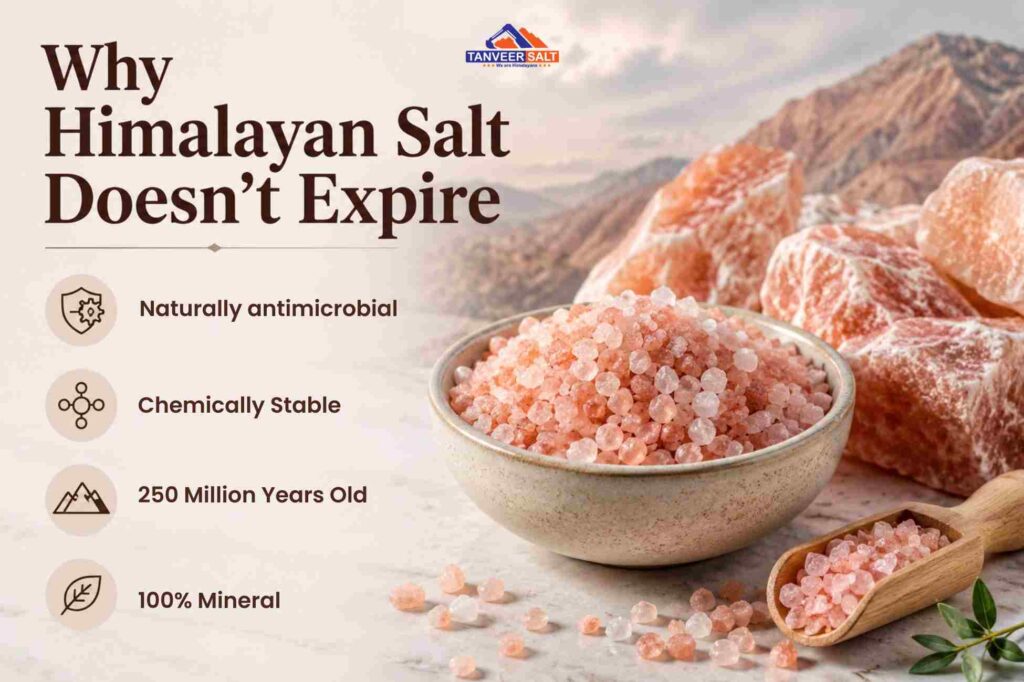
That’s Reason 1. Here’s the rest:
It’s antimicrobial. Salt doesn’t just resist spoilage it actively suppresses microbial growth, placing it in the food preservative classification humans have relied on for thousands of years. Salt that kills bacteria cannot itself be spoiled by bacteria.
Its chemical structure is rock solid. Sodium chloride (NaCl) is one of the most stable ionic compounds in nature. It doesn’t oxidise, doesn’t react with air under normal conditions, and doesn’t break down over time. Chemically, nothing happens to it.
Age says it all. Himalayan pink salt formed roughly 250 million years ago from an ancient sea evaporation deposit, compressed under tectonic pressure near the Khewra Salt Mine in Pakistan. That same organic vs inorganic compound stability that preserved it underground means your bag in the kitchen cupboard is not going anywhere.
Why Does Salt Have an Expiration Date on the Packaging?
Does salt have an expiry date, and when does salt expire exactly? This is where most people get confused and understandably so. Salt expiry date packaging requirements are a regulatory best-before date requirement and have nothing to do with whether the salt itself goes bad.
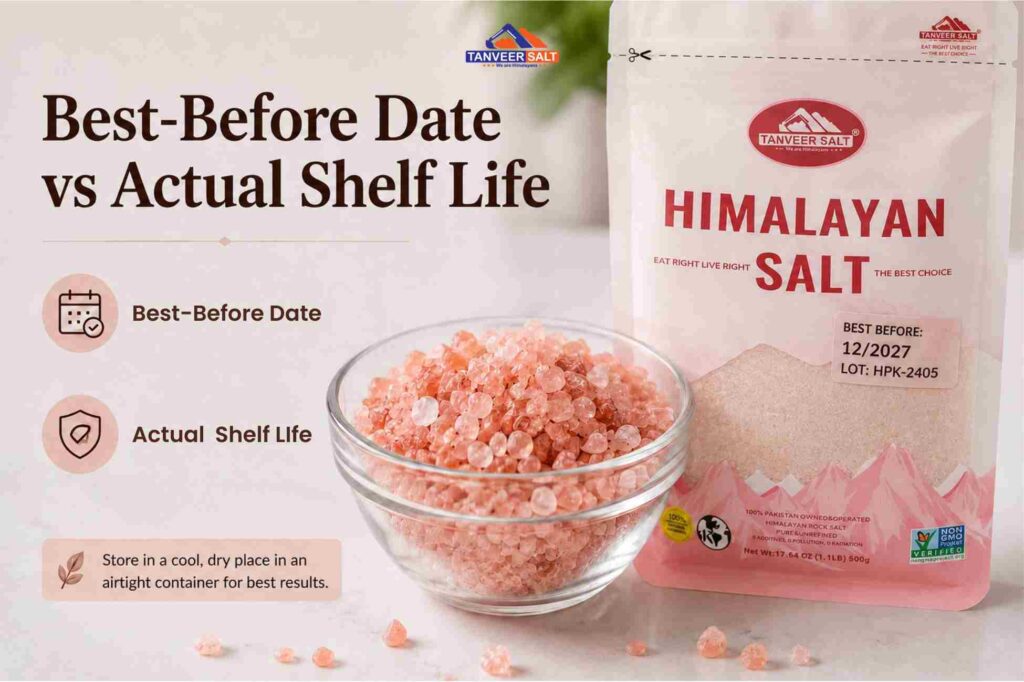
Two reasons manufacturers date-stamp salt:
- Legal compliance. FDA, EU, and most global labelling regulations require a date on all packaged foods regardless of actual shelf life, no exceptions for salt.
- Iodised table salt genuinely does have a shelf life. The added iodine potassium iodate (KIO₃) or potassium iodide (KI) degrades over roughly five years. The date exists because of iodised salt. Manufacturers apply it uniformly across all their salt products.
Here’s the key distinction: Himalayan pink salt is not iodised. It contains only trace natural iodine. Iodine degradation simply doesn’t apply to it.
If your Himalayan pink salt bag says best before 2027, the salt itself is fine; the date is a regulatory formality, not a freshness indicator.
Does Sea Salt, Rock Salt, or Table Salt Expire? All Salt Types Compared
Can Himalayan salt expire or does sea salt expire, does rock salt expire, any differently? The same principle applies to all pure, unprocessed salts; none of them expire. Here’s how each one stacks up:
| Salt Type | Expires? | Shelf Life | Notes |
| Himalayan pink salt | No | Indefinite | No iodine to degrade; store in airtight container |
| Sea salt | No | Indefinite | Trace minerals, no iodine; may clump from moisture |
| Rock salt | No | Indefinite | Does not go bad; same mineral composition and storage rules apply |
| Table salt (plain) | No | Indefinite | Heavily refined; no minerals but no degradation either |
| Iodised table salt | Yes (partially) | ~5 years | Added iodine (KIO₃/KI) degrades over time the only salt with a real expiry concern |
Bottom line: The only salt with a genuine shelf life concern is iodised table salt because of the added iodine, not the salt itself. Rock salt, sea salt, and Himalayan pink salt are all indefinite when stored correctly.
Curious whether Himalayan salt itself contains iodine? Check out our full breakdown in does pink Himalayan salt have iodine.
What CAN Go Wrong With Himalayan Salt Over Time
Can Himalayan salt go bad, or does pink salt go bad in any real sense? Not in the way food spoils but Himalayan salt quality over time can shift slightly if it’s not stored well.
Clumping. Does salt clump over time? Yes, this is by far the most common issue. Salt is hygroscopic, meaning it naturally pulls moisture from the surrounding air, leading to salt caking from moisture. That moisture causes crystals to stick together into hard lumps.
Odour absorption. Salt is porous. Store it near strong-smelling foods garlic, onions, spices and it may absorb those scents. The sodium chloride structure is unchanged, but the flavour can be affected.
Mould in flavoured blends. Pure Himalayan salt stored correctly will not grow mold but flavoured blends with herbs, spices, or organic additives can, if moisture gets in. This applies to blended products only.
Colour fading. Pink salt color change is the only cosmetic issue worth mentioning. Very prolonged exposure to strong direct light can slightly fade the colour. Entirely cosmetic. No effect on taste, quality, or the 84 trace minerals Himalayan salt contains.
When to throw out salt. Pure Himalayan salt almost never needs to be thrown out, but here are the real signs salt has gone bad: a strong off-smell that won’t air out, visible mold (only possible in flavoured blends, never plain salt), or heavy moisture damage beyond normal clumping. None of these are common and clumping alone is never a reason to discard it.
How to Store Himalayan Salt Properly — 5 Simple Tips
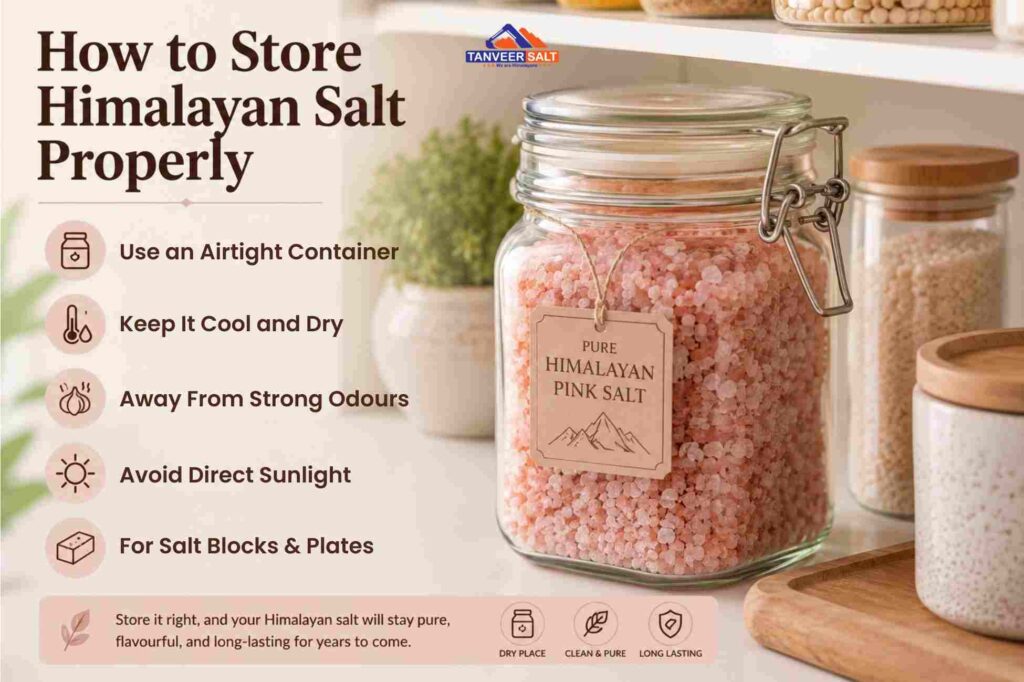
- Use an airtight container. Salt bag humidity is the biggest threat once opened airtight container dry storage matters from day one. A glass jar with a tight lid is ideal; transfer the salt as soon as the bag is opened.
- Keep it cool and dry. Away from the stove, dishwasher, and sink. Heat and steam accelerate moisture absorption.
- Store away from strong-smelling foods. Salt absorbs odours. Keep it separate from garlic, onions, and spices.
- Avoid direct sunlight for long-term storage. Prolonged light exposure can fade the pink colour over time cosmetic only, but easy to prevent.
- For salt blocks and plates. salt block shelf life is just as indefinite as loose salt, but only with proper care. Dry thoroughly after every use, store in a low-humidity area, and never submerge in water.
What not to do: Don’t leave salt in an opened paper bag or thin plastic packet. Transfer to an airtight glass or ceramic container as soon as it’s open.
Follow these five tips and your Himalayan salt will hold its full quality and flavour for years or decades.
Frequently Asked Questions
Can I use 10-year-old salt?
Yes. Pure Himalayan salt stored in an airtight container away from moisture is completely safe regardless of age, the date on the bag has no bearing on whether it’s still good.
Is it okay to use expired salt?
Yes, for Himalayan pink salt, the expiry date is a regulatory requirement, not a safety warning. Check for moisture damage or off-odours. If clear, it’s fine to use.
How long can you keep Himalayan salt?
Indefinitely. There’s no upper limit on how long it lasts when kept dry and sealed. It was preserved underground for 250 million years. Your pantry is considerably kinder to it than that.
What is the best salt for heart patients?
This is a question best discussed with a doctor or dietitian. Himalayan pink salt contains sodium just like regular table salt, so it should be used in moderation by anyone managing blood pressure or cardiovascular health. Some people prefer it for its trace mineral content, but it’s not a low-sodium alternative.
The Definitive Answer
So does Himalayan salt expire? No salt preservation is one of the rare cases in food where time simply doesn’t apply. It’s one of the few kitchen staples that truly lasts forever.
Three things to remember:
- Pure Himalayan salt doesn’t expire; it’s a mineral, not organic matter.
- The best-before date is a legal formality, not a freshness warning.
- Store it airtight, dry, and away from strong odours that’s all it needs.
Whether you use it for cooking, finishing dishes, or in a salt block, your Himalayan pink salt is in it for the long haul.
Keep Reading
- Sodium Content of Pink Himalayan Salt how much sodium is actually in each serving
- Advantages of Himalayan Salt why so many people are switching from table salt
- Himalayan Pink Salt for Cooking how to use it in everyday cooking and finishing
- Where to Buy Himalayan Salt what to look for and where to find quality pink salt
About the author
Laiba is a content specialist at Tanveer Salt Traders, a Himalayan pink salt supplier sourcing directly from the Khewra Salt Mine in Pakistan’s Salt Range.