
Sodium Content of Pink Himalayan Salt: Complete Nutrition Facts & Mineral Guide
Medical Disclaimer: This content is provided for informational purposes only and should not be considered medical advice.
Many people switch to pink salt thinking it contains far less sodium than regular table salt. However, the truth is more nuanced than most blogs suggest. The sodium content of pink Himalayan salt is only slightly lower than regular table salt, but both are nutritionally very similar in everyday use.
Pink Himalayan salt contains around 368 mg sodium per gram, while regular table salt contains approximately 381 mg per gram. In practical nutrition, that difference is very small. In this guide, you’ll learn the exact sodium numbers, Himalayan pink salt nutrition facts, the truth about the famous 84 minerals, how it compares with sea salt and table salt, and what science actually says about common health claims.
Pink Himalayan salt mainly comes from Pakistan’s Khewra Salt Mine. This site is considered one of the oldest and largest salt mining areas in the world, and it remains the primary natural source of this rock salt. Its pink color comes naturally from iron oxide and trace minerals found within the salt crystals.
How Much Sodium Is in Pink Himalayan Salt — Exact Numbers
If you are tracking sodium intake for blood pressure, kidney health, hydration, or overall wellness, understanding how much sodium is in Himalayan salt is important.
Himalayan Pink Salt Nutrition Facts
| Nutrient | Per 1g | Per ¼ tsp (1.5g) | Per 1 tsp (6g) |
| Calories | 0 | 0 | 0 |
| Sodium | 368mg | 552mg | 2,280mg |
| Calcium | 1.6mg | 2.4mg | 9.6mg |
| Potassium | 2.8mg | 4.2mg | 16.8mg |
| Magnesium | 1.06mg | 1.59mg | 6.4mg |
| Iron | 0.037mg | 0.056mg | 0.22mg |
The Himalayan salt sodium content can vary slightly depending on crystal size. Coarse Himalayan salt often contains less sodium per teaspoon because the larger crystals leave more empty space inside the spoon. Fine-ground salt packs more compactly, increasing sodium per teaspoon.
Recommended Daily Sodium Limits
- General adults: 2,300 mg/day (US Dietary Guidelines)
- High-risk groups: 1,500 mg/day (American Heart Association recommendation for people with high blood pressure, kidney disease, or diabetes)
For many adults, one teaspoon of fine ground pink Himalayan salt almost fully satisfies the recommended daily sodium limit.
Although many people believe Himalayan salt is dramatically healthier, the sodium difference between pink salt and regular table salt is only around 3%. From a nutritional standpoint, both should still be consumed in moderation.
What Are the 84 Minerals in Himalayan Salt
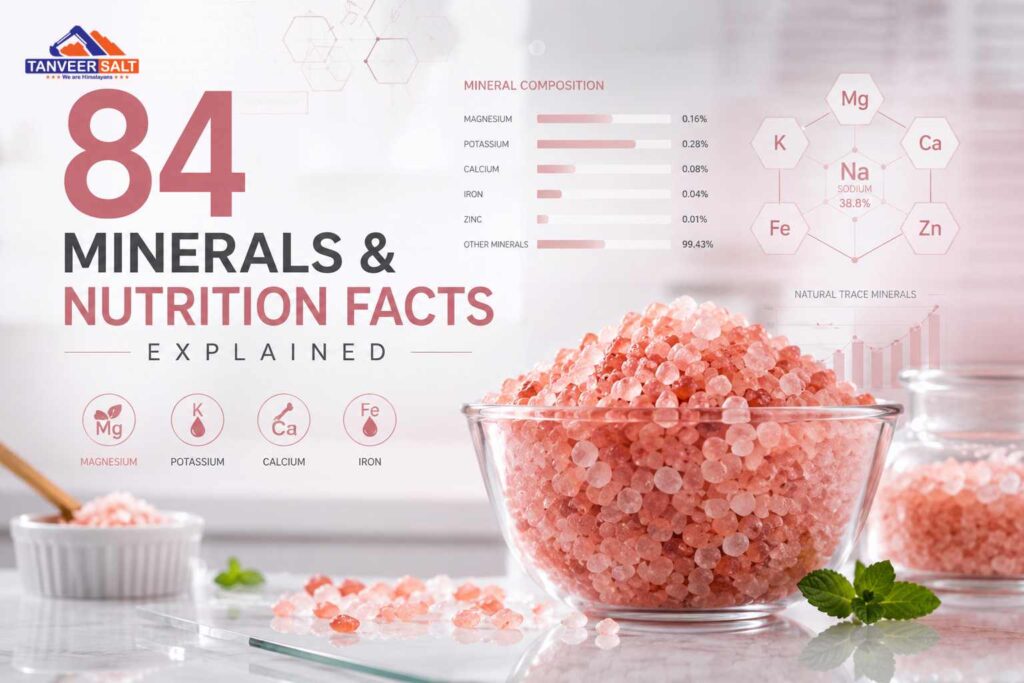
One reason Himalayan salt gained popularity is the belief that it contains “84 trace minerals.” While this statement is technically true, the actual quantities are extremely small.
Around 98% of Himalayan pink salt is sodium chloride. The remaining 2% contains small amounts of trace minerals and elements.
Tier 1 — Primary Minerals Found in Measurable Amounts
| Mineral | Amount Per Gram |
| Sodium | 368mg |
| Potassium | 2.8mg |
| Calcium | 1.6mg |
| Magnesium | 1.06mg |
| Iron | 0.037mg |
These are the minerals most commonly discussed in Himalayan pink salt nutrition information.
Tier 2 — Secondary Trace Minerals
Himalayan salt also contains detectable amounts of:
- Zinc
- Selenium
- Copper
- Manganese
- Chromium
- Molybdenum
- Strontium
- Fluoride
- Bromide
- Boron
Tier 3 — Ultra-Trace Elements
In extremely tiny quantities, Himalayan salt may also contain:
- Titanium
- Vanadium
- Cobalt
- Nickel
- Rubidium
- Cesium
- Barium
- Trace iodine
- Additional ultra-trace minerals contributing to the total “84 minerals” claim
However, these minerals exist in amounts far too small to create major nutritional benefits. For example, one banana contains around 422 mg potassium, while Himalayan salt provides only 2.8 mg potassium per gram.
Iron oxide gives Himalayan salt its pink hue. While lighter or white crystals have higher sodium chloride concentrations, darker pink crystals typically have slightly more iron oxide.
Despite marketing claims, Himalayan salt is not a major source of magnesium, calcium, or potassium. In fact, experts estimate you would need nearly 3.7 pounds of Himalayan salt daily just to meet the recommended potassium intake alone.
Himalayan Pink Salt Nutrition vs Table Salt vs Sea Salt — Comparison
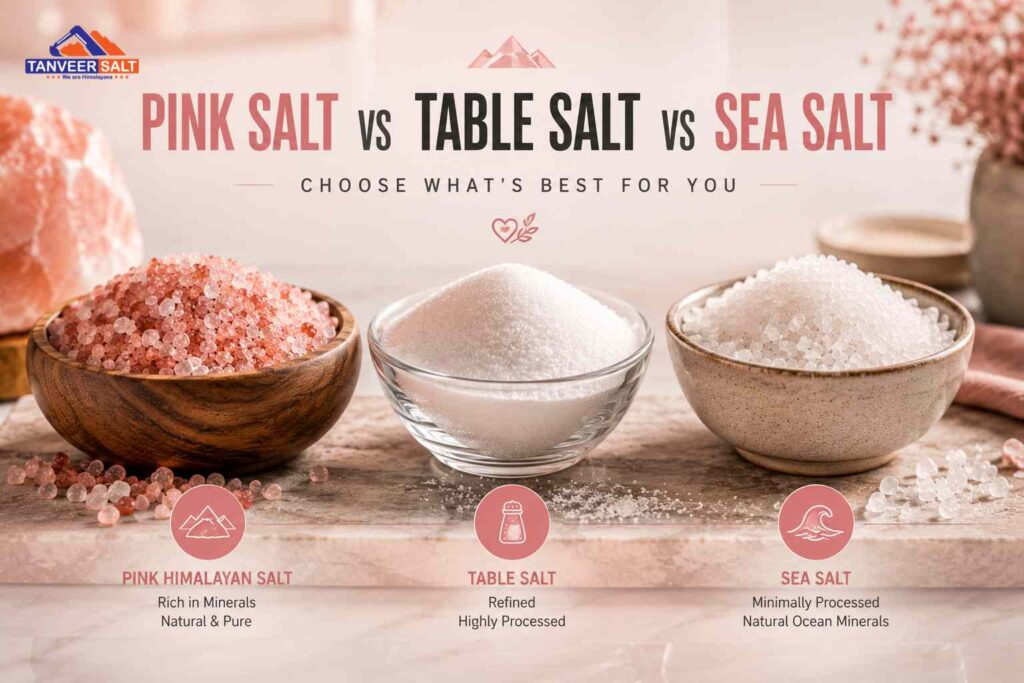
When comparing pink salt vs regular salt, most people focus only on sodium. However, iodine content, processing, and additives are also important differences.
| Type | Sodium Per Gram | Iodine Content | Processing Level | Additives |
| Himalayan Pink Salt | 368mg | Trace only | Minimally processed | None |
| Table Salt | 381mg | Fortified | Highly refined | Anticaking agents |
| Sea Salt | 390mg | Trace only | Moderately processed | Sometimes |
| Celtic Sea Salt | 348mg | Trace only | Minimally processed | None |
The most important practical difference is iodine. Himalayan salt only has trace amounts of natural iodine, whereas table salt typically has 45 micrograms of iodine per gram.
This matters because iodine deficiency may contribute to hypothyroidism and thyroid-related health concerns. People who completely replace iodized salt with Himalayan salt should make sure they obtain iodine from seafood, dairy, eggs, or other dietary sources.
Another difference is processing. Table salt is heavily refined and often includes anticaking agents such as calcium silicate. Himalayan salt is minimally processed and typically contains no additives.
Iodized table salt is still the best choice for iodine intake. For people seeking minimal processing and trace mineral variety, Himalayan salt offers a small advantage. But in terms of sodium content, all salts have very similar nutritional values.
You can also explore our related guide on Does Pink Himalayan Salt Have Iodine?
Pink Himalayan Salt Health Claims — What the Science Actually Says
Pink Himalayan salt is surrounded by many health claims online. Some contain partial truth, while others are heavily exaggerated.
Myth 1: Pink Himalayan salt provides major health benefits
Fact: Himalayan salt contains trace minerals, but the amounts are nutritionally insignificant in normal serving sizes.
Myth 2: It is better for blood pressure than table salt
Fact: Himalayan salt contains 368 mg sodium per gram compared to 381 mg in table salt. Both affect blood pressure similarly in sodium-sensitive individuals.
Myth 3: It balances body pH naturally
Fact: Your lungs and kidneys regulate blood pH very tightly between 7.35 and 7.45. No type of dietary salt can meaningfully change blood pH.
Myth 4: Eating Himalayan salt improves respiratory health
Fact: Some early research exists around salt cave therapy, also called halotherapy, but eating Himalayan salt has no proven effect on lung function.
Myth 5: The pink color means superior purity
Fact: The pink shade comes from iron oxide, not superior nutritional quality.
Myth 6: Himalayan salt contains dramatically less sodium
Fact: The sodium difference is only about 3%, which is nutritionally insignificant for most people.
The main real benefit of Himalayan salt lies in its natural, less-refined processing and lack of added chemicals, rather than significantly reduced sodium levels or exceptionally high mineral amounts.
Sodium and Health — Daily Limits, Blood Pressure & Potassium Balance
High sodium intake can disturb the body’s natural fluid balance, making it hold extra water. This increases blood volume, which puts added pressure on blood vessels and forces the heart to work harder over time. If this continues, it can contribute to higher blood pressure and raise the risk of long-term cardiovascular problems.
According to the US Dietary Guidelines, adults should stay under 2,300 mg of sodium per day. The American Heart Association recommends a lower limit of around 1,500 mg daily for people with conditions like high blood pressure, diabetes, or kidney disease. In reality, most adults consume about 3,400 mg per day, mainly from processed and packaged foods rather than salt added during cooking.
When sodium intake stays consistently high, the body retains more water, increasing pressure on the cardiovascular system and potentially leading to hypertension over time.
Research from the Archives of Internal Medicine also emphasizes the importance of maintaining a proper sodium-potassium balance, as diets high in sodium and low in potassium may increase heart disease risk.
To support better electrolyte balance, it is helpful to include potassium-rich foods in the diet, such as:
- Bananas
- Spinach
- Sweet potatoes
- Avocados
- Greek yogurt
Although Himalayan salt is often marketed for hydration or electrolyte benefits, the key factor is still moderation in total sodium intake.
Important Health Note
People with high blood pressure, kidney problems, diabetes, or similar health conditions should speak with a healthcare professional before making significant changes to their sodium intake.
FAQ
Is Himalayan pink salt high in sodium?
Yes. Himalayan pink salt contains approximately 368 mg sodium per gram and around 2,280 mg sodium per teaspoon, which is very similar to regular table salt.
Is Himalayan salt safe for Hashimoto’s disease?
Himalayan salt is not a treatment for Hashimoto’s disease. Because it naturally contains only trace iodine, people with thyroid conditions should discuss iodine intake with their healthcare provider.
What does Mayo Clinic say about the pink salt diet?
Mayo Clinic generally states that pink Himalayan salt is nutritionally similar to regular salt and should still be consumed in moderation.
How much salt is too much for CKD?
People with chronic kidney disease are often advised to stay close to 1,500 mg sodium daily, depending on their individual medical condition and physician guidance.
Is Himalayan salt better than table salt for sodium?
Not significantly. Himalayan salt contains slightly less sodium than table salt, but the difference is too small to create major health benefits.
Conclusion
The sodium content of pink Himalayan salt is only slightly lower than regular table salt. While Himalayan salt contains trace minerals and fewer additives, it should still be consumed carefully within recommended daily sodium limits.
For most people, overall sodium intake matters far more than the specific type of salt used. A balanced diet rich in whole foods and potassium-containing foods remains far more important for long-term health than switching from regular salt to pink salt alone.
You can also read our related articles:
Bathing in Pink Himalayan Salt
Cooking with Pink Himalayan Salt.
Author Bio
Reviewed by Sarah Khan, MSc Nutrition Sciences
Sarah Khan is a nutrition researcher and health content writer focused on dietary minerals, sodium intake, and public health education. Her work simplifies complex nutrition science into practical, easy-to-understand guidance for everyday readers.
Medical Disclaimer: This content is provided for informational purposes only and should not be considered medical advice.
One Response